

· Ease Solutions · monday com · 5 min read
Scaling Revenue Without Chaos: Why Spreadsheet Driven Sales Management Breaks at Scale

Why Spreadsheet Driven Sales Management Breaks at Scale
Sales growth often starts with simple tools.
Spreadsheets are used to track deals, reports are built manually, and pipeline updates rely on individual inputs. These approaches work in the early stages, but they don’t scale well.
Revenue leaders begin to lose visibility. Forecasting becomes inconsistent, and sales teams spend more time updating systems than closing deals.
This is where most organizations reach a critical point. The tools that once supported growth begin to slow it down.
At a certain point, every growing sales team faces the same question. Is the system still supporting growth, or slowing it down?
Why Current CRM Systems Slow Sales Teams Down
Modern sales teams use more technology than ever.
CRM systems, analytics tools, engagement platforms, and reporting tools are meant to improve efficiency. Instead, they often introduce friction.
According to the State of Sales Technology 2025 report, sales leaders estimate that 42.3 percent of their team’s time is lost to inefficient technology.
This includes manual data entry, disconnected tools, inefficient reporting workflows, and system complexity.
CRM systems are among the top contributors to this time loss.
The result is clear. Sales teams are busy, but not productive.
More tools do not always mean better performance.

The CRM Paradox: Why Teams Want to Replace Their CRM
CRM platforms are essential, but they are also one of the biggest sources of frustration.
Research shows that 61 percent of sales leaders report satisfaction with their CRM, yet only 21 percent believe the value exceeds the cost. At the same time, 81 percent are considering replacing their CRM within the next year.
The gap between necessity and performance creates a challenge for leadership.
Common issues include poor reporting visibility, limited integration across systems, slow performance, low user adoption, and inconsistent data quality.
For executives, this impacts decision making. Forecast accuracy drops. Pipeline visibility weakens. Revenue planning becomes reactive.

When to Replace Your CRM: Key Warning Signs
Organizations typically consider replacing their CRM when sales teams spend excessive time on manual updates and forecasting requires manual consolidation.
Other signals include lack of integration with marketing, finance, and customer success systems, limited real-time visibility, and low user adoption.
When multiple signals appear, the CRM is no longer supporting growth. It is limiting it.
Why Spreadsheets Limit Scalable Revenue Operations
Spreadsheets are flexible, but they create structural limits as teams grow.
Manual processes create delays in lead assignment and pipeline updates. As teams grow, data inconsistencies increase, and reporting becomes fragmented across departments.
These limitations directly affect sales velocity, customer response time, data accuracy, and collaboration.
As customer expectations increase, these inefficiencies become more visible.
Spreadsheet vs. Modern CRM
| Capability | Spreadsheets | Modern CRM |
|---|---|---|
| Pipeline visibility | Manual | Real time |
| Forecasting | Error prone | Centralized |
| Workflow automation | Limited | Built in |
| Cross team alignment | Fragmented | Connected |
| Reporting | Manual consolidation | Live dashboards |
| Scalability | Weak | Strong |
Why AI Powered CRM Is Gaining Ground
As CRM complexity increases, teams are turning to AI to reduce manual work and improve decision making.
Instead of acting as static systems of record, modern CRM platforms actively support decision making and automation.
More than 82 percent of sales teams report that AI improves productivity and performance.
AI capabilities now include lead scoring, forecasting, personalized outreach, reporting automation, and customer engagement workflows.
This reduces administrative workload and allows sales teams to focus on revenue generating activities.

How monday CRM Helps Revenue Teams Scale
monday CRM provides a flexible sales management platform for managing the full sales lifecycle in one place.
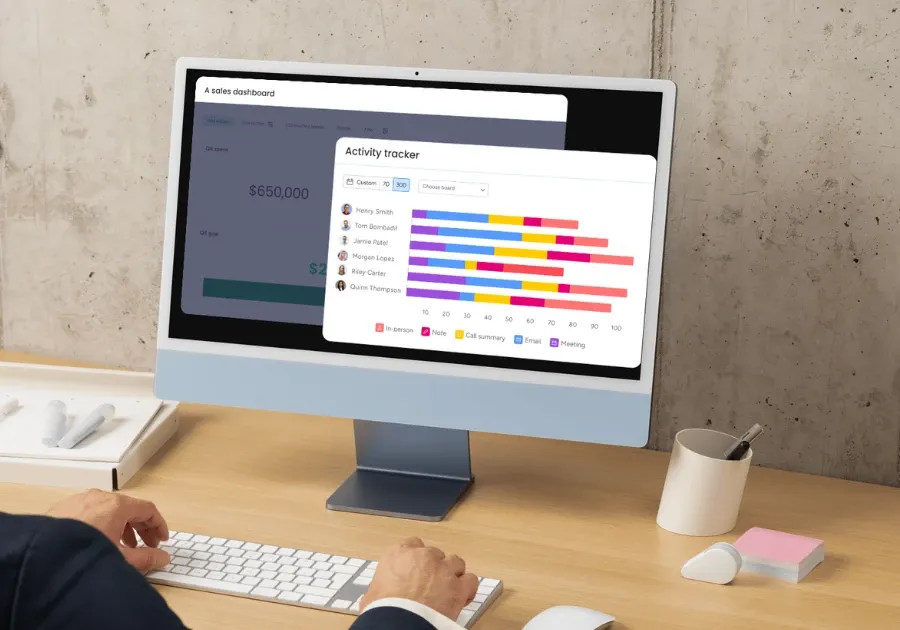
With real-time dashboards, teams gain clearer visibility, while AI capabilities support forecasting and outreach.
This reduces reliance on disconnected tools and creates a centralized system for revenue operations.

Industry Recognition: monday.com in the 2025 Gartner Magic Quadrant
monday.com has been recognized in the 2025 Gartner Magic Quadrant for Sales Force Automation.
This reflects the platform’s growing role in supporting modern revenue teams with scalable CRM capabilities.
For organizations evaluating CRM modernization strategies, this recognition signals increasing market confidence in flexible, integrated platforms.
Ease Solutions Is Both a monday.com Gold Partner and a monday CRM Specialist Partner
Ease Solutions is not only a monday.com Gold Partner, we are also a monday CRM Specialist Partner.
This distinction matters.
Gold Partner status reflects broad platform expertise, delivery consistency, and customer success across the monday.com ecosystem. The CRM Specialist Partner designation goes deeper. It validates advanced capability in CRM strategy, architecture, implementation, and optimization on monday CRM.
In practical terms, this means clients work with a partner that can support both platform adoption at scale and complex CRM transformation initiatives. We design CRM systems that improve forecasting, automate repetitive workflows, connect data across departments, and give revenue leaders clear visibility into pipeline performance.
Together, these recognitions confirm that Ease Solutions delivers more than implementation support. We provide CRM expertise that helps organizations scale revenue operations with confidence.
 |  |
Preparing Revenue Teams for 2026
Revenue organizations are evolving, and the tools that once worked before are no longer enough.
Legacy systems and spreadsheets can’t keep up with today’s complex sales processes.
AI powered CRM platforms are becoming essential for scaling operations, improving forecasting accuracy, enhancing customer experience, and aligning teams.
Organizations that modernize early will gain operational advantages.

Start with a Clear CRM Strategy
If spreadsheets and CRM friction are limiting pipeline visibility and forecast accuracy, the system needs to change.
Ease Solutions helps revenue teams implement monday CRM with:
• Clear pipeline visibility
• Consistent forecasting
• Reduced manual work
Get started for free today and experience how monday.com Sales CRM can transform your sales process!
👉 Start Your Free Trial – No credit card required!
👉 Schedule Your Free Consultation & Demo
Your success story begins here. Let’s make it happen!